
What Happens When a Cleaner Does Not Have Enough Cloths?
Recently, we have conducted several interesting cleaning audits to identify potential for increasing cleaning efficiency.
We will share some examples of the consequences of a cleaner not having enough cloths to regularly switch to clean ones or to wash all cloths together in a washing machine at the end of the workday.
Washing in the Sink
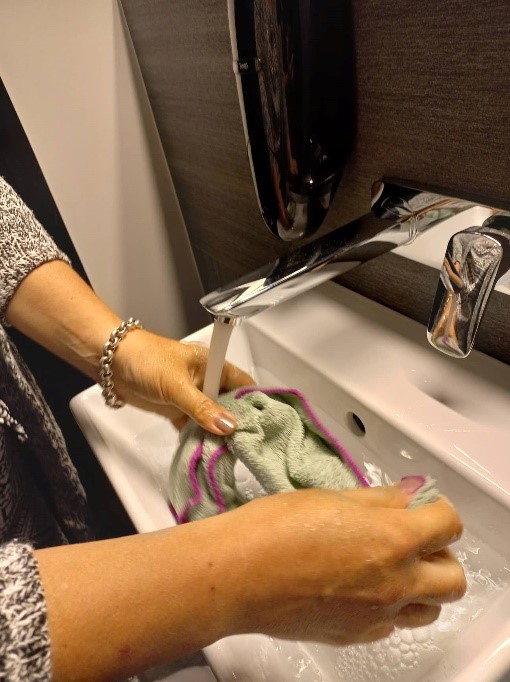 When there are not enough cloths, washing them in the sink is often the solution. However, in such cases, microfiber cloths do not get sufficiently clean and remain too wet overall. The result is that the cloth does not clean, but rather smears dirt around.
We quantified a specific case. The results were as follows:
- Washing one cloth under a tap took 1.5 minutes of working time and 3 liters of water.
- If 10 cleaners wash cloths in this manner 20 times every day, the total working time spent on this is approximately 5 hours per day.
- If this practice is followed every day for a year and the work is compensated at minimum wage, the company’s cost for remunerating this unproductive work is €11,100. This amount is significantly greater than the cost of acquiring microfiber cloths, a trolley, and even a washing machine.
- This consumes 600 liters of water per day. Based on the above, that’s approximately 180 tons more water per year than would be used for washing cloths in a washing machine.
Use of Paper Towels
If a cloth is washed under a tap or is wet/dirty for any other reason, there is still a need to dry surfaces like taps and sinks. Often, paper towels are used. During a recent audit, we counted how much paper was actually used. That day, the result was 5-7 sheets of paper per toilet. If this is done in one hundred rooms, an average of 600 sheets of paper are used for drying per day. In this institution, the paper cost was 0.8 cents per sheet, so the total cost of paper for drying is €4.8 per day, to which waste management costs are added. Annually, the cost of paper for drying is €1,752. Drying with a microfiber cloth would certainly yield significantly better results.
It is important to spare employees, avoid unnecessary water consumption, and consider how the time invested in cleaning can be value-creating.
Environmental requirements for cleaning apply in Estonia from 1 January, which, among other things, also focus on reducing water consumption. Read the article HERE.