
Presentation of the Results of the Project “Cost-effective Needs-Based Cleaning – INSTA 800”
Puhastusekspert is an international leader in the cleaning sector in Estonia. We consider it important to teach and guide others, as well as to be learners ourselves. To gather knowledge and educate ourselves, Puhastusekspert initiated the international Erasmus+ project “Cost-effective Needs-Based Cleaning – INSTA 800”. INSTA 800 (in Estonia, EVS 914 Agreement and Assessment of Cleaning Work Quality) is an official standard in seven countries. For this purpose, partners from Denmark, Sweden, Finland, Norway, Iceland, and Latvia were involved to share their experiences with the standard and, consequently, to create new materials that would harmonise its application. We presented the project results at a seminar held on 25 May.
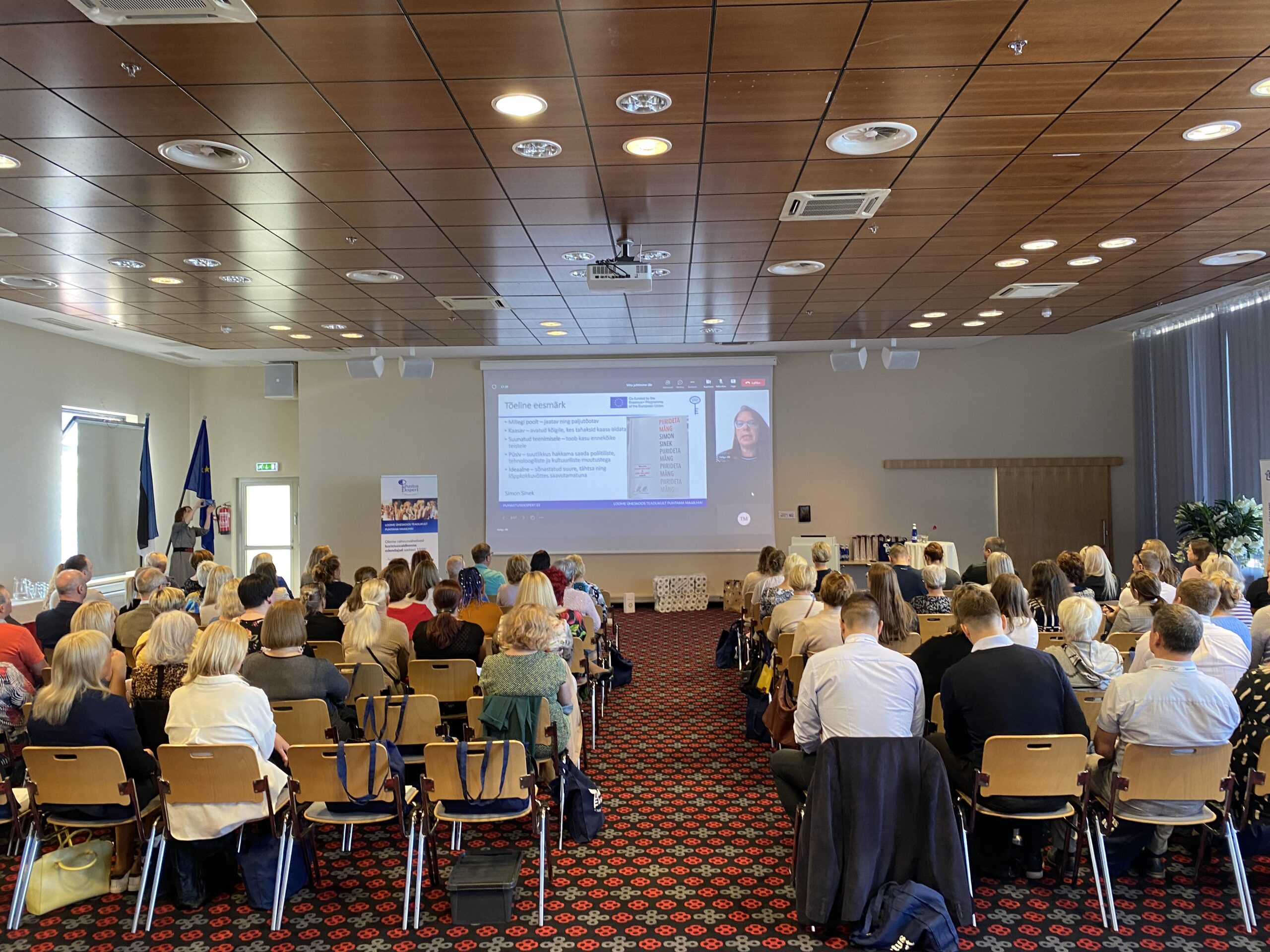
With this project, we hope to broadly convey the idea that cleaning should primarily focus on results, and only the activities that most effectively remove dirt from surfaces that are actually dirty should be performed. In other words, the value of working time should be increased.
INSTA 800 is a good tool that helps us agree on cleanliness levels and assess whether the agreed cleanliness has been achieved, and to precisely identify what needs more attention in cleaning and what needs less, so that working time has maximum value.
The project resulted in:
- Sharing experiences of using INSTA 800 in seven countries. You can find a valuable collection of experiences in seven languages on our website HERE.
- Cleaning time matrices for five typical room types. We conducted 900 experiments to determine how much the dirt level before cleaning and the expected cleanliness level affect actual working time. We conducted the experiments in five typical room types: office, restroom, corridor, classroom, and staircase. It can be stated that, according to INSTA 800, each added level of expected cleanliness or level of dirt before cleaning means a 15-20% increase in working time.
- Effective training programmes and methodologies for INSTA 800 for different knowledge levels. We analysed standard-compliant training courses in various countries and concluded that training at levels 3 and 4 is generally satisfactory and effective, but knowledge level 2, i.e. training for cleaning staff, needs improvement. There was also a lack of effective ways to convey information to clients. In June 2022, a meeting between partners will take place in Riga, where we will test the innovative training programmes developed within the project.
Time Spent on Cleaning and its Value
Working time is the largest cost of cleaning services, despite the fact that the salaries of cleaning staff are often low. Workloads are typically defined on a square metre/hour basis. However, the question arises as to what basis the “norms” are set on. Cleaning time is actually influenced by many different factors. In the project experiments, we aimed to observe only the impact of dirt level and the expected cleanliness level on working time.
The goal was to measure the impact of dirt and cleanliness on working time, but we gained several other valuable lessons, which can be summarised as follows:
- When washing with a machine, detergent residues were still being removed for weeks, which highlighted the true extent and problem of overdosing. If surfaces have cleaning agent residues, it acts like a layer of glue for dirt to adhere to.
- In practice, the amount and age of dirt before cleaning both have a greater impact on working time. Older dirt requires more time to remove, even though the amount may be the same according to INSTA 800. Therefore, it is advisable to remove dirt promptly.
- Cleaning staff “want to clean” habitual spots, but not spots where dirt actually needs to be removed. It is important to teach cleaning staff to notice and remove dirt based on need. It is especially worthwhile to analyse floor cleaning, as generally, floors only need to be cleaned when they are visually dirty.
- It is important to define a realistic quality profile and to train cleaning staff accordingly, so they can effectively remove dirt that should not be on surfaces.
- At the beginning of the service period, it is advisable to immediately conduct a level assessment and rectify any cleaning deficiencies. Only then is it possible to organise cleaning optimally. It is important that the service buyer has clearly defined how deficiencies will be rectified – whether through a separately purchased deep cleaning or by including additional work in the service price. Depending on the situation, this can be very time-consuming. The INSTA 800 standard includes a corresponding point in chapter 9.
- Excessive cleaning and cleaning of already clean surfaces is an unplanned common activity, meaning unnecessary working time is spent.
- At the beginning of the contract, the client and the service provider must agree on how damaged surfaces are to be inspected, and it is important to differentiate between dirt and damaged surfaces.
- It is important to immediately remove stains from walls, textiles, and similar places during maintenance cleaning, because over time they become fixed and difficult or impossible to remove.
- The type of dirt determines the method – it is important for cleaning staff to know how to choose between dry, slightly damp, damp, and wet methods. Incorrect methods (too wet, too dry) leave layers on surfaces, which are much more time-consuming to remove.
- The cleanliness and condition of cleaning textiles and accessories are important; otherwise, unnecessary excess working time is spent, and dirt remains unremoved, or surfaces are merely smeared.
- It is important to define a needs-based frequency, meaning cleaning is done when too much dirt has accumulated on surfaces. Soiling usually occurs in connection with activities in the room and visitor traffic. Therefore, electronic visitor monitoring can be beneficial for making optimal decisions that help increase the value of working time.
- If there is less furniture in the rooms, it is reasonable to use higher quality levels to achieve the desired standard. The reason is that, for example, furniture is less likely to get dirty.
- Trained and aware cleaning staff spend significantly less time achieving the same level of cleanliness. The experiment showed a difference of 33%, so quality training that helps people act based on need is a key issue.
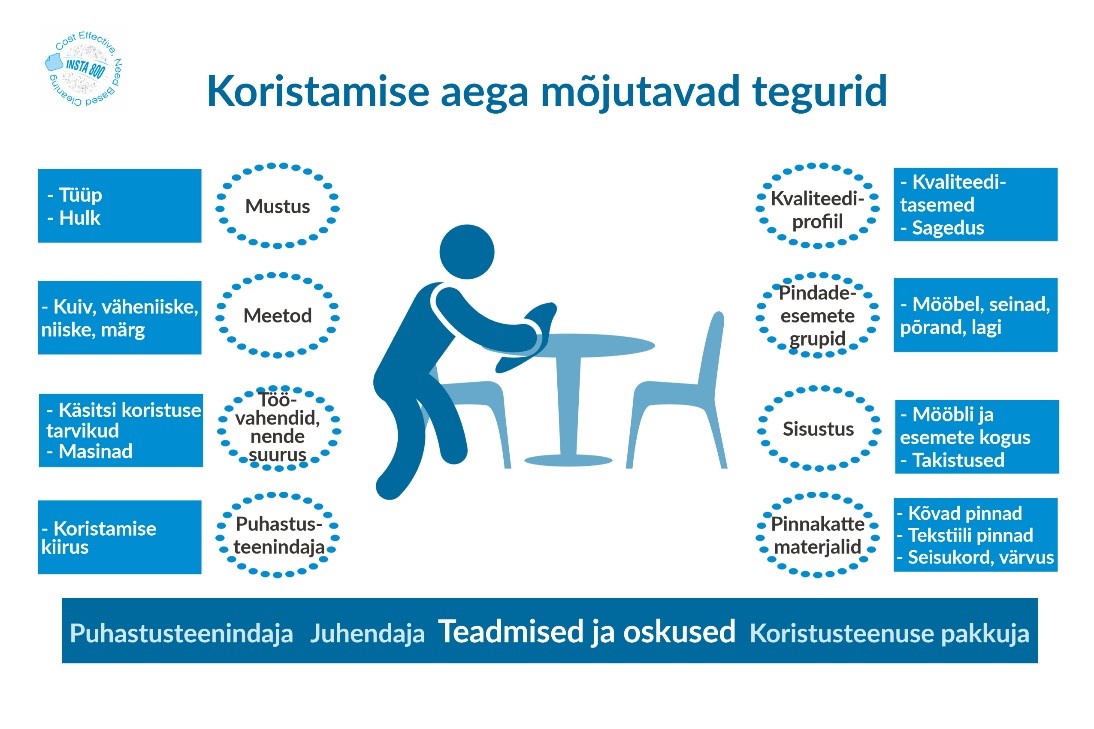
Training is a Key Factor in Implementing Cost-Effective and Results-Based Cleaning
Throughout the project, it became clear that one of the most important factors is the awareness of employees – cleaning managers, cleaning staff, and also client representatives. The INSTA 800 standard defines the following knowledge levels:
- knowledge level 1 – service provider management
- knowledge level 2 – cleaning staff
- knowledge level 3 – supervisors, inspectors (effective and for improvement)
- knowledge level 4 – planners, representatives responsible for procurement, consultants, trainers (effective and for improvement)
In the project, we were primarily streamlining the methods of educating cleaning staff and clients. The results will be published on the Puhastusekspert website in the second half of 2022.
Summary of Benefits from Implementing INSTA 800:
- The focus is on the result; as a result of using INSTA 800, cleaning quality improved and complaints decreased.
- Other problems external to the service are also easily discovered, allowing for better cooperation.
- Cleaning managers who had encountered results-based cleaning also performed better on other sites.
- Awareness is a key factor – cleaning manager, cleaning staff, cleaning service buyer.
- INSTA 800 is a good tool for those who care about satisfaction with cleaning.
- INSTA 800 works when used as prescribed by the standard.
- Correct use of the standard creates exceptional opportunities for satisfactory and sustainable cooperation between the service provider and the buyer.
- If cleanliness is created consciously and the working time, work results, and work processes are monitored, then there are significant opportunities to increase the VALUE of working time spent on cleaning and achieve the required cleanliness with lower costs, saving working time and environmental resources.