Study Trip to Italy 27-30 May 2025
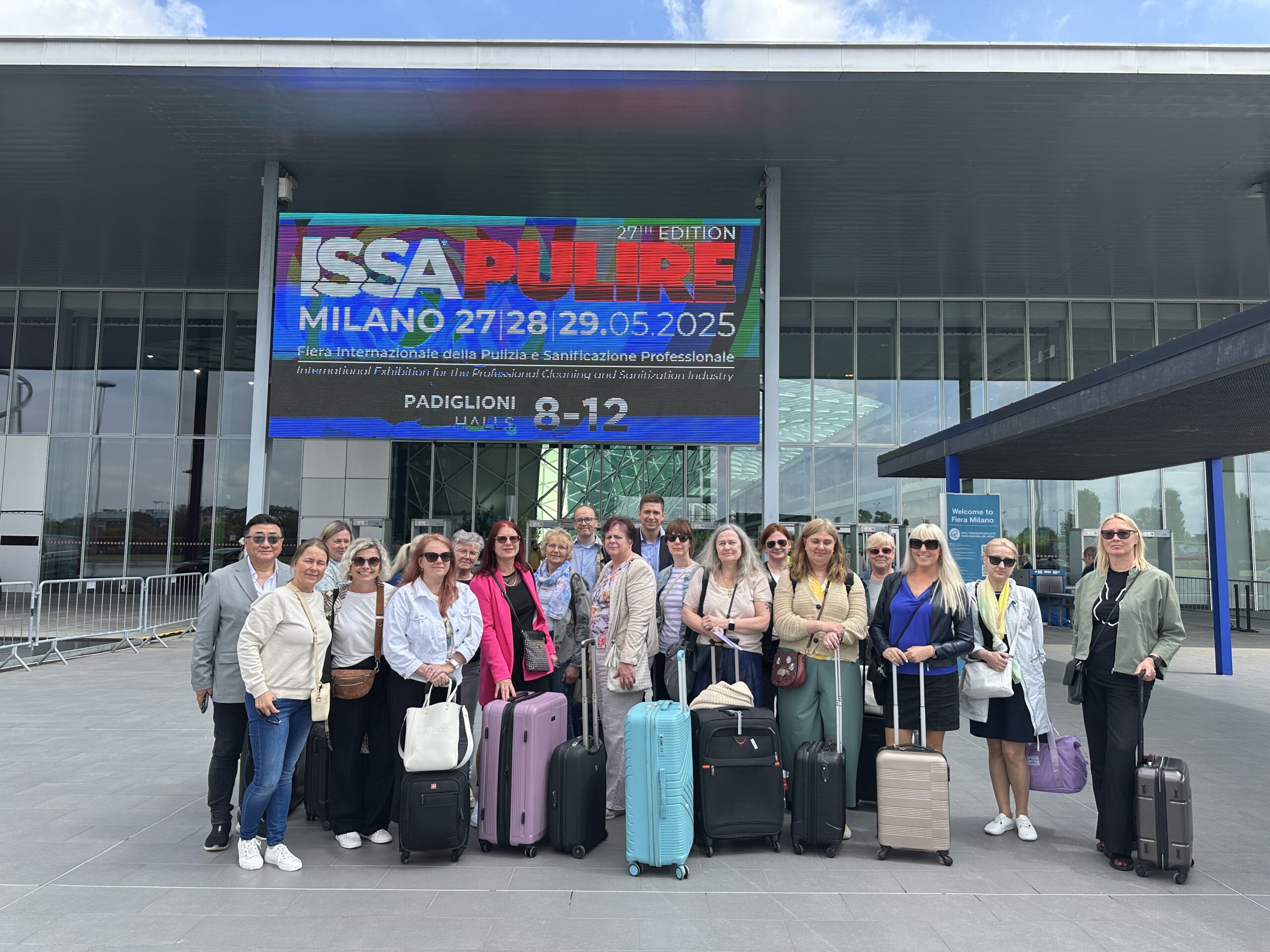
Led by Puhastusekspert, another inspiring and substantive Erasmus+ learning mobility project took place from 27-30 May 2025, with Milan, Italy as its destination this time.
Participants in the project included P.Dussmann, Eesti Liinirongid AS, Tartu Rakenduslik Kolledž, Uma Puhastus OÜ, Viljandi Haigla AS, Elva Haigla AS, SOL Baltics OÜ, North Estonian Medical Centre, Tartu Health Care College, and Arkaadia Puhastus OÜ. The study trip was supported by Erasmus+ consortium learning mobility projects no. 2023-1-EE01-KA121-VET-000133792 and 2024-1-EE01-KA121-VET-000236654.
The aim of the study trip was to gain an overview of the practices, technologies, organisation of sustainable procurement, and work arrangements in the Italian cleaning sector, to understand how cleaning companies are managed sustainably, and how infection control is ensured in Italy. Furthermore, it aimed to expand international contacts and bring best practices to the development of the Estonian cleaning sector by developing the competencies of cleaning sector trainers.
Participants in the project included P.Dussmann, Eesti Liinirongid AS, Tartu Rakenduslik Kolledž, Uma Puhastus OÜ, Viljandi Haigla AS, Elva Haigla AS, SOL Baltics OÜ, North Estonian Medical Centre, Tartu Health Care College, and Arkaadia Puhastus OÜ. The study trip was supported by Erasmus+ consortium learning mobility projects no. 2023-1-EE01-KA121-VET-000133792 and 2024-1-EE01-KA121-VET-000236654.
The aim of the study trip was to gain an overview of the practices, technologies, organisation of sustainable procurement, and work arrangements in the Italian cleaning sector, to understand how cleaning companies are managed sustainably, and how infection control is ensured in Italy. Furthermore, it aimed to expand international contacts and bring best practices to the development of the Estonian cleaning sector by developing the competencies of cleaning sector trainers.
How is cleaning done differently in Italy?
A peculiarity of the Italian cleaning sector is that the market largely features machines, supplies, and paper products manufactured in Italy. Professional associations include both cleaning service providers and manufacturers. There is a recognised need to develop the sector by training both manufacturers and service providers together. Significant steps are being taken in the development of cleaning to ensure that the competencies for various cleaning service positions are standardised across Italy and more broadly in Europe. An excellent unified system exists for this purpose, the European Qualification Framework, which is not currently in use in Italy but is being aimed at. We are proud to say that the same system has been in use in Estonia for over 20 years, and we can advise organisations in Italy in this regard. Read more about EQF qualification awarding here.

ISSA Pulire 2025 – Europe’s Leading Cleaning Exhibition
The ISSA Pulire exhibition in Milan was one of the most important parts of the study trip. It is one of Europe’s largest exhibitions for professional cleaning services and technologies, where, in addition to product and equipment presentations, we also participated in seminars, workshops, and conference presentations. The most interesting topics included cleaning ergonomics, optimisation of work methods, measuring and improving cleaning efficiency, air purity and ventilation requirements, innovative cleaning solutions, cleaning procurement requirements in Italy, and the implementation of ESG principles in the cleaning sector.


Innovation in Cleaning
At the ISSA Pulire exhibition, the winners of the cleaning innovation awards were announced, and our consortium also decided to choose its favorites. Here are our top five:
5. Ergotec Window Cleaning Gloves
Window cleaning gloves that keep your hands dry and warm even in cold conditions. Rubber details ensure a firm grip, and the design combines comfort and functionality.
Consortium comment: The gloves do not get wet inside and are very comfortable. We particularly liked that your hands stayed warm during window cleaning. Although the gloves are thick, they are still comfortable to work with.
4. Unger Green Label accessories for glass cleaning
The first certified sustainable accessory series for professional glass cleaning. The products hold C2C Material Health Certificate™ Silver, EU Ecolabel, and FSC Mix Credit certifications. High quality and environmental friendliness are combined with professional needs.
Consortium comment: A well-thought-out product series where each accessory has its purpose. The design is appealing and functional.
3. Makita PS001GZ Cordless Floor Care Machine
A very light (under 2 kg) machine that enables cleaning in places large machines cannot reach – ideal for cleaning stairs and even walls.
Consortium comment: It impressed us with its powerful 40V battery, compact design, and adjustable telescopic handle. Speed regulation, a soft start, and LED lighting make operation smooth and professional. A wireless, powerful, ergonomic, and versatile tool suitable for various fields.
2. DRYFT Floor Scrubber
The world’s first S-Motion floor scrubber-dryer, which cleans up to 100 m² in just 3.9 minutes. Efficient cleaning is achieved with a vibration frequency of 4200 rpm. The patented cleaning handle makes using it feel like mopping.
Consortium comment: A small and compact machine, well-suited for hard-to-reach areas. Comfortable to use and gives the feeling of mopping.
1. I-Walk Co-Botic – our consortium’s favourite and the innovation award winner
Can transform the I-mop into a robot. Highly efficient – up to 700 m² cleaned with a single charge. Easy to set up and a sleek design.
Consortium comment: I-Walk impressed with its smart sensor technology, enabling autonomous and precise navigation. It does not replace the worker but supports them by reducing physical strain and taking over routine tasks. The worker can focus on more meaningful tasks, which increases job value and motivation. Innovation lies not only in technology but also in a new approach to human-machine collaboration.
Additionally, we had the opportunity to shadow at several large companies, such as Kiehl, Unger, Cartiere Carrara, and Sprintus. During the shadowing, we tested various cleaning supplies and machines and confirmed their effectiveness. We also had the chance to try different cleaning methods and compare processes in Estonia and Italy. We highly appreciated the opportunity to ask questions and get answers directly from the source.
5. Ergotec Window Cleaning Gloves
Window cleaning gloves that keep your hands dry and warm even in cold conditions. Rubber details ensure a firm grip, and the design combines comfort and functionality.
Consortium comment: The gloves do not get wet inside and are very comfortable. We particularly liked that your hands stayed warm during window cleaning. Although the gloves are thick, they are still comfortable to work with.
4. Unger Green Label accessories for glass cleaning
The first certified sustainable accessory series for professional glass cleaning. The products hold C2C Material Health Certificate™ Silver, EU Ecolabel, and FSC Mix Credit certifications. High quality and environmental friendliness are combined with professional needs.
Consortium comment: A well-thought-out product series where each accessory has its purpose. The design is appealing and functional.
3. Makita PS001GZ Cordless Floor Care Machine
A very light (under 2 kg) machine that enables cleaning in places large machines cannot reach – ideal for cleaning stairs and even walls.
Consortium comment: It impressed us with its powerful 40V battery, compact design, and adjustable telescopic handle. Speed regulation, a soft start, and LED lighting make operation smooth and professional. A wireless, powerful, ergonomic, and versatile tool suitable for various fields.
2. DRYFT Floor Scrubber
The world’s first S-Motion floor scrubber-dryer, which cleans up to 100 m² in just 3.9 minutes. Efficient cleaning is achieved with a vibration frequency of 4200 rpm. The patented cleaning handle makes using it feel like mopping.
Consortium comment: A small and compact machine, well-suited for hard-to-reach areas. Comfortable to use and gives the feeling of mopping.
1. I-Walk Co-Botic – our consortium’s favourite and the innovation award winner
Can transform the I-mop into a robot. Highly efficient – up to 700 m² cleaned with a single charge. Easy to set up and a sleek design.
Consortium comment: I-Walk impressed with its smart sensor technology, enabling autonomous and precise navigation. It does not replace the worker but supports them by reducing physical strain and taking over routine tasks. The worker can focus on more meaningful tasks, which increases job value and motivation. Innovation lies not only in technology but also in a new approach to human-machine collaboration.
Additionally, we had the opportunity to shadow at several large companies, such as Kiehl, Unger, Cartiere Carrara, and Sprintus. During the shadowing, we tested various cleaning supplies and machines and confirmed their effectiveness. We also had the chance to try different cleaning methods and compare processes in Estonia and Italy. We highly appreciated the opportunity to ask questions and get answers directly from the source.

Job Shadowing at San Raffaele Hospital
Milan’s San Raffaele Hospital was one of the highlights of our study trip. It is one of Italy’s largest and most prestigious private hospitals, where we observed the organisation of the entire cleaning cycle, from preparation in the cleaning room and cleaning of general areas and operating rooms to the completion of cleaning tasks. San Raffaele Hospital, founded in 1971, is a research hospital and the polyclinic of Vita-Salute San Raffaele University, offering specialised treatment for the most complex health problems, and was recognised in 1972 as an institute for diabetes research and treatment. This hospital has over 60 specialised clinical units and receives 1.9 million patients annually. The hospital’s cleaning practices were of a high standard but differed somewhat from those used in Estonia. For example, pre-moistening textiles, wetting bottles, or pre-cleaning mops before washing in a machine were not used. At San Raffaele Hospital, there was a strong dedication to patient satisfaction – patients should feel as if they are in a hotel and also receive first-class medical care.


Interesting Insights from the Study Trip:
Author: Jaanika Kasemets