Why Should the Toilet Lid be Closed when Flushing?
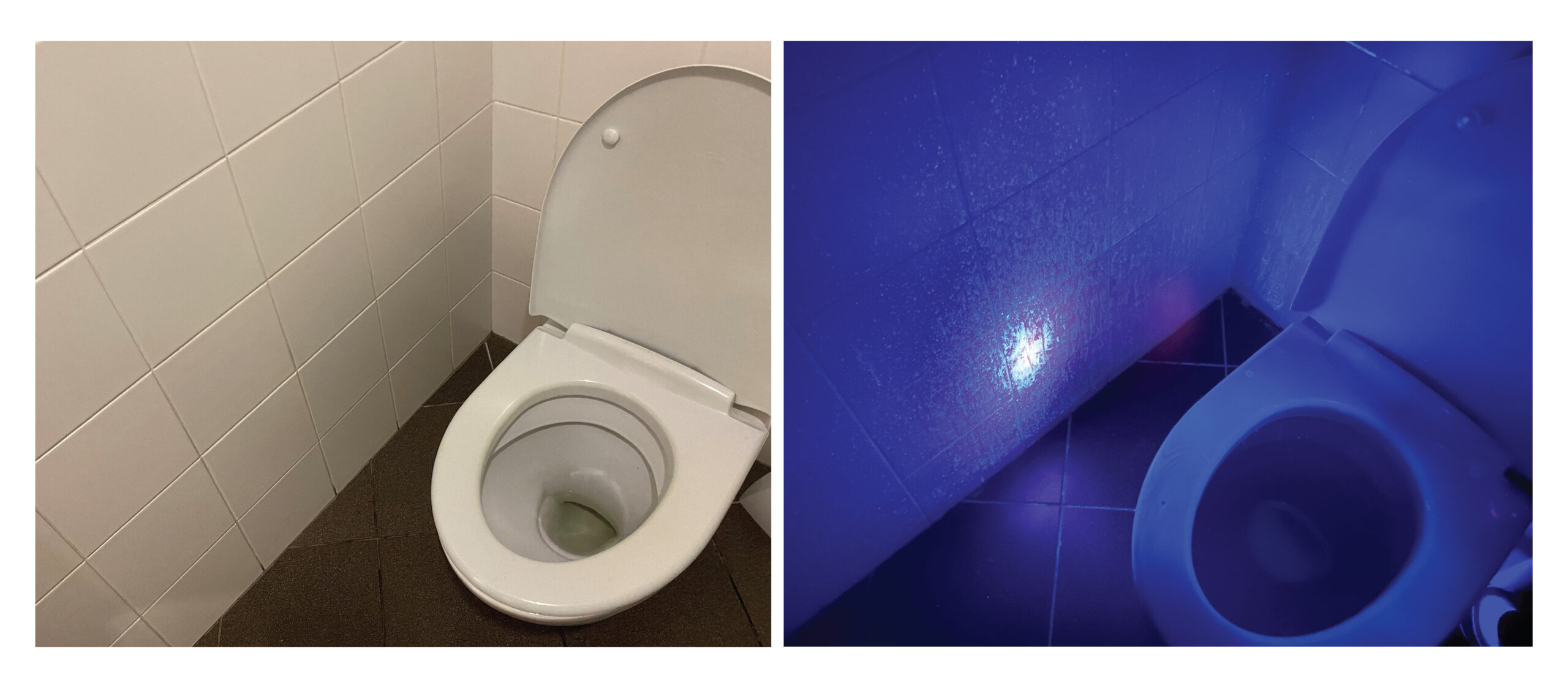
Based on our extensive experience, we can state that the cleanliness of restrooms is the most deceptive, and splashes from the toilet stain walls and create an unpleasant odor. At first glance, surfaces appear clean and neat, but a truly shocking sight is revealed when we turn off the lights and illuminate surfaces with a UV lamp.
We have reviewed studies that actually show that when leaving the lid up, the problem is not just a shocking sight, but also a real danger of promoting the spread of various infectious diseases.
Here are some studies:
A 2012 study in the USA states that restrooms can contribute to the spread of infectious diseases, and that the topic requires further research, especially in healthcare facilities. This study highlights a possible link with norovirus, SARS, and pandemic influenza.
A 2011 study conducted in the UK showed that when flushing with the lid up, there were 12 times more C. difficile (a disease causing diarrheal illnesses) particles in the air than when the lid was down. It was specifically highlighted that leaving the lid up can play a critical role in the spread of diarrheal diseases.
A 2018 study in the USA highlights that in healthcare facilities, the level of contamination in restrooms without toilet lids is significantly higher than with toilets with lids. Consequently, there is an increased risk of disease transmission, especially for gastrointestinal diseases.
A 2014 study in Italy confirms the same, that toilets are highly contaminated areas in healthcare facilities.
Conclusions:
- Always put the toilet lid down before flushing.
- Regularly clean the area around the toilet. This is especially important in toilets used by many people, where it cannot be guaranteed that everyone will put the lid down.
- In conscious cleaning, crucial importance lies in asepsis (the correct order of cleaning surfaces), cloth folding, appropriate moistening, and wiping mechanics. Otherwise, we just spread the dirt, and the situation is even worse.
- Parallels can be drawn regarding the possibility of COVID-19 spreading in public restrooms (supported by wastewater studies conducted in Estonia on the spread of COVID-19).